O2 Sensor Reading 5 Volts While Unplugged
Dan Ferrell writes almost do-information technology-yourself motorcar maintenance and repair. He has certifications in automation and control technology.
Acquire How to Check an Oxygen Sensor
Learning how to check an oxygen sensor (O2) will help y'all ostend a potential problem with the sensor in your vehicle before you spend fourth dimension and coin replacing a unit of measurement that might non even need a replacement in the first place. Oxygen sensors detect the amount of oxygen content in the exhaust stream and turn this information into a voltage point that your car reckoner uses to control fuel ratio and emissions.
However, whenever the sensor's bespeak changes—and stays out of—its normal operating parameters, it causes the computer to store a trouble code in memory and turn a malfunction indicator low-cal (MIL) or Check Engine calorie-free on your dashboard to alarm you of the problem.
Still, whether you suspect a bad oxygen sensor or a estimator trouble code points to a potential consequence with the O2 sensor, the trouble may lay somewhere else. All the computer does is inform you where the problem was detected. For example, you may accept a loose or torn vacuum hose, causing the sensor to read a abiding loftier rate of oxygen in the exhaust stream; or the sensor electrical connector may accept become loose, preventing the device from working. Instead, the reckoner detects a sensor abnormal operation.
So earlier replacing the unit, you lot can utilize the sensor'southward operating characteristics to verify whether you actually need to supervene upon it.
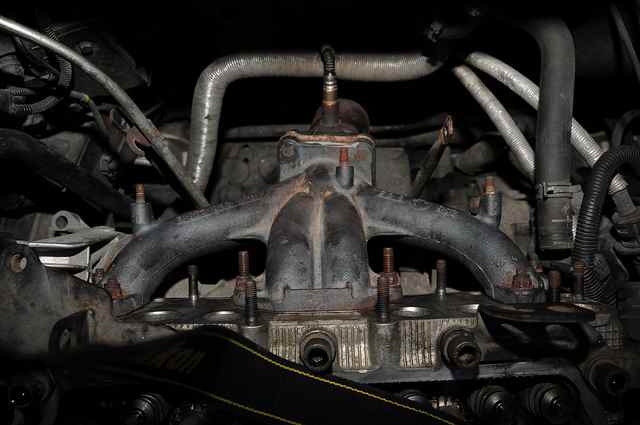
An oxygen sensor may be located about the exhaust manifold.
photo courtesy of 50.C. Nøttaasen on Flicker
Connecting Your Voltmeter to the Oxygen Sensor
To run this test, you will need a 10-megaohm impedance digital voltmeter. Nearly digital voltmeters come with a 10-megaohm protection to foreclose the meter from drawing also much electric current and damaging electrical or electronic components during a test.
Also, before you lot start your tests, locate the oxygen sensor you want to troubleshoot. On pre-1996 vehicle models, y'all'll detect the sensor normally on or virtually the exhaust manifold. On 1996 and newer models, you'll see a sensor near the exhaust manifold, and some other 1 near the catalytic converter. Notwithstanding, some vehicle models take up to 5 or more sensors. Make sure you know which sensor yous need to cheque.
When you lot retrieve diagnostic trouble codes (DTC) from your automobile figurer, you may too become information about the specific sensor at mistake, depending on your scan tool features. For instance, y'all may go a Bank I, sensor i at error, which points to the O2 sensor on or nigh the exhaust manifold on the cylinder head that contains cylinder number one. A depository financial institution I, sensor two, points to the sensor on the same side simply further down the frazzle system, probably right before or after the catalytic converter. The same goes for the other cylinder caput—on 5 type engines—which is considered Bank II.
To locate Banking concern I and Depository financial institution Two, consult your vehicle service manual, if necessary.
Then, if the sensor you're testing has more than one wire (heated sensor), locate the bespeak wire by consulting your vehicle service manual, if necessary.
- A single-wire sensor uses that wire as the signal wire.
- Ii-wire sensors use one wire for the sensor's signal and the other i to ability the heater.
- Three-wire models, use 1 wire for the betoken and the other two wires to power and footing the heater.
- Iv-wire sensors, though, employ one of the wires to ground the sensor itself.
To identify the wires await at the wiring diagram in your vehicle repair transmission. If you don't have the manual, purchase an inexpensive, aftermarket manual for your specific vehicle make and model at your local auto parts store or online.
- One time you have the appropriate voltmeter on hand and have located the sensor, warm upwardly your car engine to operating temperature. Yous can practise this by taking your auto for a twenty-infinitesimal drive on the highway or idling the engine for nearly 15 to 20 minutes at a fast idle speed.
- Turn off the engine and set up your voltmeter to the mV (millivolt) DC scale.
- If y'all are testing an O2 sensor near the catalytic converter, elevator your vehicle using a floor jack and safely support the vehicle on a couple of jack stands and block the rear wheels.
- Be careful when connecting your meter. When the engine is at operating temperature, the exhaust manifold and pipes are extremely hot. Don't burn down yourself and keep your meter and probes away from hot surfaces.
- On sensors with one to three wires, connect the meter's red probe to the sensor'southward betoken wire and the meter's blackness probe to a skilful ground on your engine. On four-wire sensors, connect the meter's black probe to the sensor's footing wire. If necessary, consult the wiring diagram in your vehicle repair manual.
To connect your meter's probe to the wire, use a wire-piercing probe or dorsum probe the sensor through the connector. With some sensors, though, it'due south hard to back probe the signal wire through the connector. To overcome this limitation, you can unplug the sensor and connect a strand of copper wire to the connector prong for the indicate wire, and plug back in the electric connector, leaving the stretch of wire sticking out of the connector. This will requite you a bare wire you lot can connect to your meter probe for the test. Just make certain the blank wire doesn't touch ground.
Another option is to pierce the sensor's betoken wire through the insulation with a pin and connect the meter probe to the pin. Merely keep the pivot from touching ground.
If you make up one's mind to become with the latter method, after you stop your tests remove the pin and encompass the pierced section of wire with electrical tape to prevent wet and corrosion from creeping into the wire.
| The Oxygen Sensor Helps Reduce: |
|---|
| Hydrocarbon |
| Carbon monoxide |
| Oxides of nitrogen |
Reading the Oxygen Sensor's Signals
Start the engine and bank check the sensor's voltage signals on your voltmeter. The sensor voltage should cycle or fluctuate within the 100 mV-900 mV (0.10 to 0.90V) range approximately. This means the sensor is operating properly.
If the O2 sensor only produces a low- or loftier-voltage signal, either you lot have an engine performance issue or the oxygen sensor stopped working. To verify sensor operation, conduct the next 2 tests.
Test the Oxygen Sensor Response to a Lean Fuel Status
- Get-go, disconnect the hose from the positive crankcase ventilation (PCV) valve leading to the intake manifold. This will let more air to enter the engine. If yous demand to locate the PVC valve, consult your vehicle service manual.
- Check the sensor's signal voltmeter reading. An oxygen sensor interprets an increase in oxygen as a fuel lean condition and emits a signal shut to 200mV (0.20 V). If the sensor doesn't respond accordingly or takes time to answer, the sensor isn't working properly.
- Reconnect the hose to the PCV valve.
Exam the Oxygen Sensor Response to a Rich Fuel Condition
- Disconnect the plastic duct from the air cleaner assembly on your vehicle.
- Block the duct opening leading to the engine with a clean rag. This volition reduce the corporeality of air going into the engine.
- Check the sensor's signal voltmeter reading. An oxygen sensor interprets a decrease in oxygen as a rich fuel condition and emits a indicate close to 800mV (0.eighty 5). If the sensor doesn't reply accordingly or takes time to respond, the sensor isn't working properly.
- Reconnect the air duct to the air cleaner associates and turn off the engine.
Read More from AxleAddict
If the oxygen sensor in your vehicle responded correctly to your tests, yous might take a problem with another component affecting fuel efficiency. The engine may take a vacuum leak, a problem in the ignition system or something similar. If your sensor didn't respond properly to your tests, the sensor has stopped working and yous demand to replace information technology.
Digital Multimeters
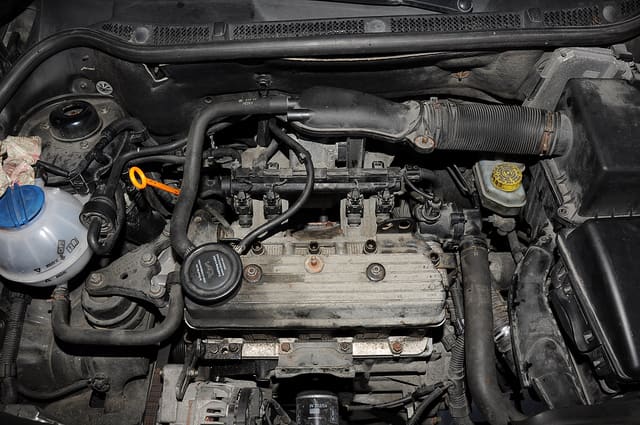
Replace the oxygen sensor at the recommended manufacturer interval for meliorate engine performance.
photo courtesy of L.C. Nøttaasen on Flicker
One time y'all know how to cheque an oxygen sensor, y'all tin can verify whether the unit is actually working or in demand of replacement. These tests will save you money and time—and help you lot fix your vehicle sooner. As well, yous might want to check the service interval for your O2 sensor in your repair manual. Every bit driving miles accumulate, exhaust byproducts cover the tip of the unit that protects the sensing element. Then the sensor efficiency drops, causing engine functioning problems. Eventually, the sensor stops working. And so it's a good idea to supersede information technology at the recommended schedule to restore fuel efficiency and reduce emissions.
This article is accurate and true to the best of the author's knowledge. Content is for informational or entertainment purposes but and does not substitute for personal counsel or professional advice in business, financial, legal, or technical matters.
Questions & Answers
Question: My rear o2 sensor is 2 fixed in 0.vii voltage. Is this normal?
Answer: The rear sensor monitors the catalityc converter job. The downstream O2 sensor fluctuates very footling if the cat is working properly. Voltage reading probably an average of 0.v volts and sometimes higher.
Question: Can a bad O2 cause a P0430 code?
Answer: Information technology is possible. The oxygen sensor located downstream from the catalytic converter is usually the one that makes the ECU throw this code. This O2 is a cat monitor, and when the reckoner senses the catalytic is not doing its job based on the feedback from this sensor, it lights the CEL. Still, other faults can make this lawmaking appear, similar an exhaust leak, a bad O2, a misfire or a leaking fuel injector.
Question: What is the stationary percentage setting for the 02 sensor?
Answer: The average for that sensor is 0.5. It constantly fluctuates between 0.ix and 0.1, approximately.
Question: If i of the four oxygen sensors is bad, volition that crusade the bad sensor to throw codes for all of them? Or does multiple oxygen sensor malfunction sound more similar a ground wire result?
Respond: This would exist more like a ground wire problem.
Question: What if the O2 sensor bends are not?
Answer: Use a sensor adapter. As long as the head of the O2 remains in the stream, it'll work.
Question: The front sensor on my 07 Subaru Outback hangs out around 350mV at idle and doesn't seem to fluctuate from there. Blocking the air intake to the filter box didn't practice annihilation, and disconnecting the hose from the PCV valve caused the engine to rev in waves til it eventually stalled. Does the fact that the sensor didn't fluctuate indicate an consequence with it?
Answer: The front sensor should exist constantly fluctuating betwixt (most) 0.1 and 0.nine volts.
Question: My 8.1 dies going down the highway. I turn the fundamental off, information technology starts right upwardly and runs great for a while before quitting. What could exist the problem?
Answer: This other mail might help you:
https://hubpages.com/auto-repair/Why-My-Engine-Sta...
Question: How can I get the OEM original sensor?
Answer: Check with your local dealer.
Question: Is it possible for an o2 sensor to go bad without throwing a CEL?
Respond: If the sensor is worn only still within the working parameters, information technology won't trigger a trouble code.
Question: My O2 sensor is reading 0.4xx no matter what the conditions are (idle or load). LTFT is also high (+32% idle and +12% load). There aren't whatsoever error codes. The engine is a 1.half-dozen 16V AUS (VW). The O2 sensor is also new/ Does this mean a bad point or a footing wire to O2?
Answer: It seems like a vacuum leak. Check for leaks using carburetor cleaner. They are hard to find sometimes. A smoke test, if necessary. Other potential bug: a bad IAC (idle air control) valve, EVAP solenoid, EGR valve.
Question: Can I test the voltage on a downstream air sensor in the exhaust while unplugged? Like pulling it out and using a torch idea?
Reply: Yeah. The heat from the propane torch eliminates the oxygen from around the sensor, which causes the sensor to ship a voltage betoken.
Question: On my scanner, the oxygen sensor reads a stock-still 1.5 volts and 10% lean condition. Tin a sensor accomplish one.five volts? Is the sensor broken?
Answer: A titania oxygen sensor can read upwardly to 1.5 volts, and they read in the contrary direction (low voltage will point to a rich status while a high voltage will signal a lean condition – others fluctuate between 0 to 5 volts. Bank check the type of system your vehicle uses first and operating parameters. Yous may find this information in your vehicle repair manual. It may also tell you how to examination the sensor.
Question: Why would my engine RPM increment when I pump my break peddle?
Respond: The master cylinder might be leaking and fluid entering the brake booster. Applying the brakes tin send the fluid into the engine, having that extra boos issue in rpms.
Question: Every source says to "backprobe" an O2 sensor. The O2 sensor is a bimetallic junction that produces a voltage when heat is practical. And I did just measure out a voltage with the sensor disconnected from the harness and measuring only the sensor'southward signal wire and ground, engine running. So, is there a valid test protocol doing information technology this way?
Answer: Actually, the recommended tests brand utilise of a scope or browse tool, while monitoring sensor switching response fourth dimension while idling, and load conditions. I haven't heard of a specific protocol to use while the sensor is unplugged though.
Question: One of the cables bankrupt on my oxygen sensor. Is it possible to set seeing as though information technology is connected to the exhaust manifold and gets so hot? At the interruption of the cable is correct at the sensor.
Answer: It might be possible but I think you lot'd be amend off replacing the sensor.
Question: I've checked my O2 sensor output voltages using an OBD scanner. The downstream sensor fluctuates between 0.1 and 0.9 5. The upstream sensor isn't giving me any output, only a nuance on the scanner tool display. My LTFT hovers around 35% on idle and drops close to zero at load. Any idea what's going on?
Answer: Seems like there could be a vacuum leak. This may include a leaking EVAP purge valve and crankcase ventilation system.
Question: How does the front 5 wire oxygen sensor work?
Reply: That'south commonly referred to as an air/fuel ratio (wide band) oxygen sensor. These newer sensors output a 0-5 volt signal to the engine control unit (ECU). This video here gives you a skilful caption of how it works:
https://www.youtube.com/watch?v=zjefDrFH_6c
Question: My check engine light is on for my Nissan Maxima 2000. I've been told it'due south both downstream sensors, which I'll endeavor to supplant myself considering they're charging a chip. Is the reflashing necessary or should I exercise that first to encounter if information technology's even the sensors? I am trying to bustle for inspection. Oh, and what tools would you lot recommend?
Answer: Yous tin double check by going to one of your local automobile parts stores and have them download the trouble codes for y'all. If yous desire to supercede them yourself, utilise an oxygen sensor socket. Bank check them online to see which one volition conform better for your needs (check the position of the sensors in your vehicle). You lot may demand an extension to employ with your ratchet. This other post may help:
https://axleaddict.com/motorcar-repair/How-to-Replace-...
Clear the codes later on replacing the sensors.
Question: Can a bad 02 cause a P2195 code?
Answer: At that place could be several reasons for this lawmaking to appear: fuel injector issues, MAF sensor issues, low fuel system pressure, vacuum leaks, a leaking PCV system, and of course a faulty O2 sensor or excursion.
Question: Can I have the Ohms value for these sensors?
Respond: Look up the specs in the repair manual for your particular vehicle make and model. If you don't have the manual, check the reference section of your local public library for information technology. Identify the heater terminals and check resistance with your multimeter. Compare your readings with those listed in your manual. If the values don't match, supplant the sensor.
Question: Where are the 02 sensors on my auto?
Answer: Look down the frazzle header pipe(s), On modern cars, there'southward 1 right before the catalytic converter and ane after. Older vehicles used only i earlier the cat.
Question: My 2010 VW Tiguan has a high gas consumption. I checked the live data with my scanner and I have STFT -8 and LTFT -iii. My O2 sensor shows me 0.780 mv, which ways Rich status. Could my car'due south high gas consumption exist because my O2 is bad? I don't have a cheque engine light either.
Reply: Make sure y'all don't really have a rich condition, there could exist a leaking fuel injector or another issue. Maybe this other post can help:
https://axleaddict.com/auto-repair/Why-My-Car-Cons...
Source: https://axleaddict.com/auto-repair/How-to-Check-an-Oxygen-Sensor
0 Response to "O2 Sensor Reading 5 Volts While Unplugged"
Post a Comment